
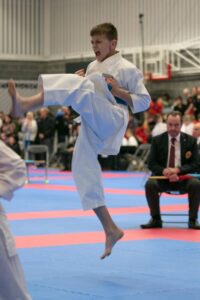
 At Simon Coope Karate School, we are proud to teach Wado Ryu, one of the four major styles of Japanese karate. While many people have heard of Shotokan or Goju Ryu, fewer understand what makes Wado Ryu different and why it has such a distinctive place in the world of martial arts.
Wado Ryu is known as the way of peace. It blends strong traditional karate techniques with the softness and fluidity of Japanese jujutsu, creating a style that values timing, movement, and harmony over force. This philosophy shapes everything we teach, from the way students step into the dojo to the way they respond to challenges in everyday life.
The Origins of Wado Ryu
Wado Ryu was founded in Japan by Hironori Ohtsuka in the early 1900s. Before learning karate, Ohtsuka was already a master of traditional jujutsu. When he later studied Okinawan karate, he recognised an opportunity to combine the two arts. The result was Wado Ryu, a style that emphasises redirecting energy rather than meeting strength with strength.
This blend of softness and striking power makes Wado Ryu both elegant and highly effective. It reflects Japanese martial arts culture, where awareness, calmness, and movement are just as important as physical strength.
How Wado Ryu Compares to Other Major Styles
Many karate styles share common roots, but each has its own personality, training methods, and philosophy. Here is how Wado Ryu stands out from the others.
Shotokan
Shotokan is powerful, linear, and emphasises strong stances and long-range techniques. Movements are sharp and direct. While Shotokan often focuses on strength and precision, Wado Ryu uses lighter, more natural movement. Instead of blocking forcefully, Wado Ryu teaches students to evade and flow around attacks.
Goju Ryu
Goju Ryu translates to hard soft style. It mixes close range techniques, circular motions, and breathing forms. Wado Ryu shares the soft principles but uses even more evasion and body shifting from its jujutsu roots. Where Goju Ryu often meets an opponent at closer range, Wado Ryu encourages stepping off the line of attack entirely.
Shito Ryu
Shito Ryu is known for having an extensive collection of kata. It is a very technical style with a wide variety of stances, strikes, and blocks. Wado Ryu is more streamlined, with fewer kata and a stronger focus on movement principles like tai sabaki, which teaches students how to safely reposition the body during an attack.
Each of these styles has its strengths, but Wado Ryu stands out because of its harmony between softness and power. It teaches efficiency rather than force, control instead of aggression.
The Heart of Wado Ryu Movement
The central principle that makes Wado Ryu unique is tai sabaki, the art of body shifting. Rather than blocking with strength, students move their bodies out of the line of attack, using angles, timing, and awareness to neutralise threats with minimal force.
This approach teaches children and adults how to stay calm under pressure, remain aware of their surroundings, and use intelligent movement instead of relying solely on power.
Wado Ryu also emphasises distance, balance, and smooth transitions. Every movement has purpose, and every technique reflects the harmony between mind and body.
The Influence of Jujutsu
Wado Ryu is the only major karate style that incorporates direct jujutsu elements. Students learn principles of evasion, joint control, redirection, and body awareness. This gives Wado Ryu practitioners a deeper understanding of how to use an opponent’s energy rather than resisting it.
These teachings are especially valuable for children, who may not have the strength to rely on force. Instead, they learn how to move effectively, stay safe, and remain confident.
Why We Teach Wado Ryu at Simon Coope Karate School
Wado Ryu reflects the values we want to pass on to all our students. It encourages respect, humility, calmness, and peace of mind. It also builds confidence, flexibility, discipline, and control while offering a highly effective self defence foundation.
- Students learn to
- Stay relaxed under pressure
- Move with intention and precision
- Understand the purpose behind every technique
- Develop balance and coordination
- Train with respect and awareness
This foundation supports progress not just in karate but in everyday life, helping students grow into confident and responsible individuals.
A Style Connected to Japan
Our team and students have visited Japan to train, learn, and experience Wado Ryu in its birthplace. Seeing the art practised in traditional dojos and at national championships highlights the deep cultural values behind the style.
The emphasis on humility, unity, and peaceful intention is felt everywhere, from the etiquette of bowing to the quiet concentration before each training session. These experiences strengthen our commitment to teaching Wado Ryu with respect for its origins and traditions.
Every karate style has its strengths, but Wado Ryu offers something truly special. It blends powerful karate techniques with the softness of jujutsu, creating a martial art that values harmony over force and control over aggression.
At Simon Coope Karate School, we are proud to pass on the traditions of Wado Ryu to children, teens, and adults across Leicestershire. Through patient practice and mindful training, students discover that the greatest strength comes from clarity, calmness, and character.