
Starting karate can feel exciting and a little overwhelming at the same time. New students are introduced to stances, strikes, and blocks that may seem unfamiliar at first.
Parents searching for kids’ karate near me often ask what their child will actually learn in the early stages of training. The good news is that beginners start with a clear foundation of simple, essential movements.
These basic techniques form the building blocks for everything students learn as they progress in karate.
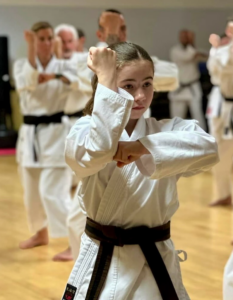
Why Beginners Focus on Fundamentals
Karate is built on strong foundations. Before students move on to complex combinations or sparring, they learn fundamental techniques that develop balance, coordination, and control.
These basics teach the body how to move efficiently and safely.
When beginners practise these movements regularly, they begin to develop the muscle memory needed for more advanced techniques later on.
1. Front Stance (Zenkutsu Dachi)
The front stance is one of the first positions beginners learn.
It teaches students how to distribute their weight correctly while maintaining balance and stability. A strong stance allows punches and blocks to be performed with greater power and control.
2. Nia Hanchi Dachi
Similar to horse riding stance it strengthens the legs and develops lower body stability.
Students learn to hold this stance while performing punches and blocks, which improves posture and endurance.
3. Straight Punch (Junkuki)
The straight punch is a fundamental striking technique used in many karate combinations.
Beginners practise this movement repeatedly to develop correct alignment, speed, and accuracy.
4. Rising Block (Jodan Uke)
The rising block is used to defend against strikes aimed at the head or upper body.
Learning how to block correctly teaches students that karate is not only about attacking, but also about protecting themselves.
5. Downward Block (Gedan Barai)
This block protects the lower body and helps students understand defensive movement.
Practising blocks also improves coordination between the arms and body.
6. Front Kick (Mae Geri)
The front kick is often the first kicking technique beginners learn.
Students practise lifting the knee, extending the leg, and returning the foot with control. This develops balance and lower body strength.
7. Knife Hand Block (Shuto Uke)
The knife hand block introduces students to open-hand techniques and different defensive angles.
It also teaches students how to rotate the hips to generate power.
8. Back Stance (Kokutsu Dachi)
The back stance helps students learn how to shift weight and maintain stability during defensive movements.
This stance is often used when performing blocking techniques.
9. Side Kick (Sokuto)
The side kick develops hip strength and control.
Students practise this kick slowly at first to ensure proper balance and accuracy.
10. Ready Position (Yoi)
The ready position teaches students how to stand calmly and prepare for movement.
It reinforces focus and discipline before beginning any technique.
Building Confidence Through Practice
These techniques may appear simple, but they are incredibly important.
Through repetition, students develop coordination, strength, and confidence in their movements. Each class builds on the previous one, allowing beginners to progress gradually.
Children quickly realise that improvement comes through practice rather than rushing ahead.
A Strong Foundation for Karate Training
The basic moves taught in early karate training create a foundation that supports every future skill.
Parents looking for children’s karate classes near me often appreciate that beginners start with clear, structured learning.
These first techniques teach more than just movement. They build confidence, focus, and discipline that stay with students throughout their training journey.